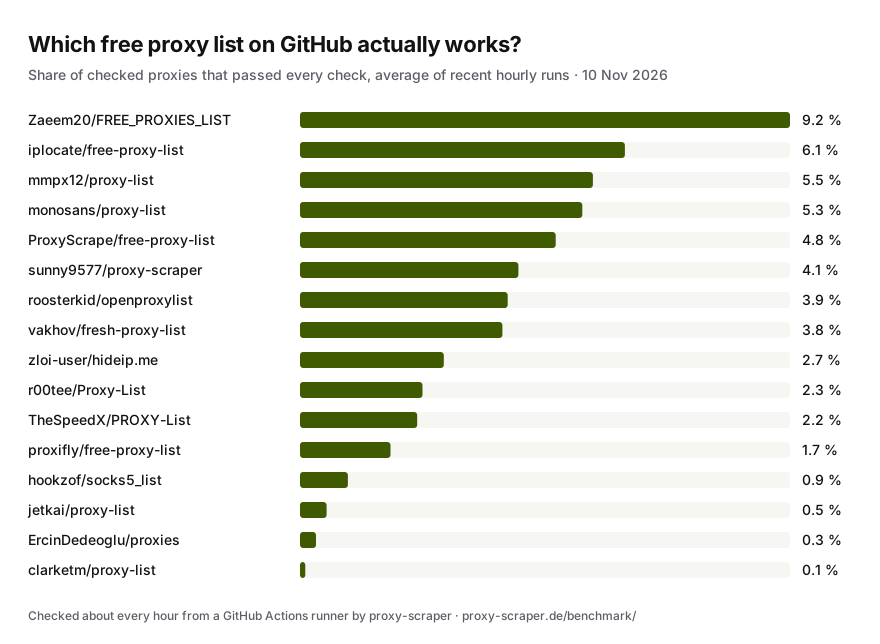
How it's measured
About every hour a GitHub Actions runner downloads each of these lists and checks its proxies.
A proxy passed every check when it got through all three:
- a real HTTP, SOCKS4 or SOCKS5 handshake that returns a foreign exit IP,
- a second request to another site that has to show the same exit IP,
- a static test page that has to arrive unchanged, byte for byte.
Share is the proxies that passed against the proxies checked from that list. Both are averages
of recent runs in which every run counts twice as much as the one before it, so the latest run makes up about half
and the last few hours almost all of it. Proxies listed is the latest successful download, which
is why checked can come out a little above it.
One run checks only the most promising part of the candidates from all the lists it knows, so of a big list
only a part is checked each time. That part is not a random sample: proxies that worked before go first. A proxy
that several lists carry counts for each of them, and all files of one repository count as one list. Lists with
fewer than 300 proxies checked per run are shown without a place.
This is one measurement from one data center network, not a judgment of the maintainers. Many of these lists
publish what they collect without filtering it, refresh at different times or are meant for other uses; a low share
mostly means that many entries were offline or didn't pass at the moment they were checked. From your own network
the numbers can differ.
proxy-scraper's own published list is not in the table. It is made of the proxies that passed these same checks
an hour earlier, so measuring it with them would not be a fair comparison.
Every list it knows, not only these, is ranked on the sources page. The same
numbers from your own network: proxy-scraper --list-sources.
 proxy-scraper